MATERIALISM TRAP
Articles from our Materialism Trap Edition.
The Blessing That Became a Snare

Dr. Gladys Childs
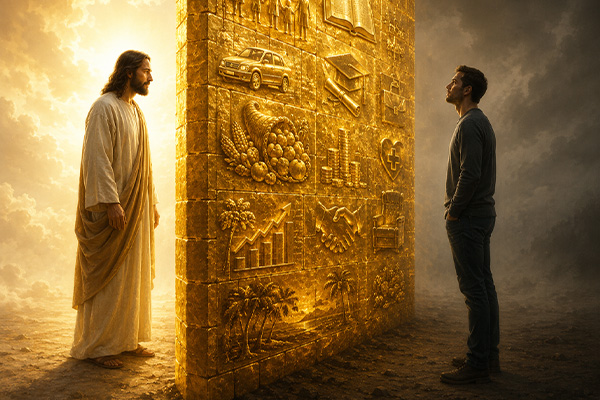
We spend years praying for what we do not have, then years discovering what God's gifts reveal about our hearts. The first test is faith. The second is worship. Judges 8 tells the story better than almost anywhere else in Scripture.
Gideon takes three hundred men against a force too large to count. God hands him Midian. "Rule over us, you and your son and your grandson also," they say (Judges 8:22, ESV). He refuses, and for a moment, everything sounds right. "I will not rule over you, and my son will not rule over you; the LORD will rule over you" (Judges 8:23).
The hardest idols to spot are the ones God handed us. So how do we tell when a blessing has become one?
Then, in the next breath, he asks for the earrings.
Gold from the plunder, seventeen hundred shekels, was made into an ephod and set up in his hometown of Ophrah. Scripture does not soften it: "and all Israel whored after it there, and it became a snare to Gideon and to his family" (Judges 8:27).
Watch it happen. The gold came from a victory God gave. The snare got built out of the blessing. God won the battle, the spoils came home, and the spoils became the shrine.
The earrings should stop us cold. The last time Israel pooled golden earrings, they pulled them from their own wives and sons and carried them to Aaron, who made a calf (Exodus 32:2-4). Centuries later, another pile of golden earrings took God's people down the same road. Hosea saw it happen to a whole nation: "She did not know that it was I who gave her the grain, the wine, and the oil, and who lavished on her silver and gold, which they used for Baal" (Hosea 2:8). The grain came from His hand, and the oil, and the silver melted down for a rival. Idolatry seldom kicks off with rebellion; it starts with amnesia.
The hardest idols to spot are the ones God handed us. So how do we tell when a blessing has become one? The difference never shows up in the object. Moses named the moment it turns, when the houses go up, the herds multiply, and the heart says, "My power and the might of my hand have gotten me this wealth" (Deuteronomy 8:17). His correction hangs on the verb we skip: "You shall remember the LORD your God, for it is he who gives you power to get wealth" (Deuteronomy 8:18). Remember. That is where blessings become idols or remain gifts.
Which means the gold in our hands proves nothing. A man wanted Jesus to make his brother divide an inheritance. Jesus went after his heart instead. "Take care, and be on your guard against all covetousness, for one's life does not consist in the abundance of his possessions" (Luke 12:15). He ended the parable of the rich fool with the phrase: “rich toward God” (Luke 12:21). There is the line. Gold that drives us back to the Giver is a blessing. The same gold standing between Him and us is a shrine. Nothing around Gideon had changed. He was still standing in the same field, wearing the same armor, when he asked for the earrings. Only his heart had turned.
Notice what God did not do. He did not withhold the victory because Israel might mishandle the spoils. He entrusts good gifts. The gift corrupts no one. It exposes what already lives in the heart. The most dangerous idols are often fashioned from God's gifts because we already know those gifts are good. Gold from a victory God gave is often the hardest thing to hold with an open hand.
Before the story ends, run it against your own house. What began as an answer to prayer now competes with the One who answered it? What blessing do you instinctively protect, depend on, or fear losing more than your nearness to Christ?
The land had rest for forty years. Then Gideon died, and Israel turned again to the Baals, making Baal-berith their god (Judges 8:33). Read that against Judges 8:27 and notice the same word used for both. The snare did not end with Gideon.
The consequences reached beyond him. His son Abimelech received silver from the house of Baal-berith, then returned to his father's house at Ophrah and killed his seventy brothers on one stone (Judges 9:4-5).
Ophrah. The same address.
Jotham, the youngest, hid and lived to speak the truth from Mount Gerizim. Seventy of his brothers did not. Gideon would not take a crown. His gold bought one for a son who murdered to wear it.
So name the gold. It is whatever we prayed for and received, whatever we would now argue with God to keep, the thing occupying the space where hunger for Him lived. Carry it back to Him with both hands open, and some of us will find our fingers do not unbend easily. Better to learn that today, while the ephod is still only gold.